
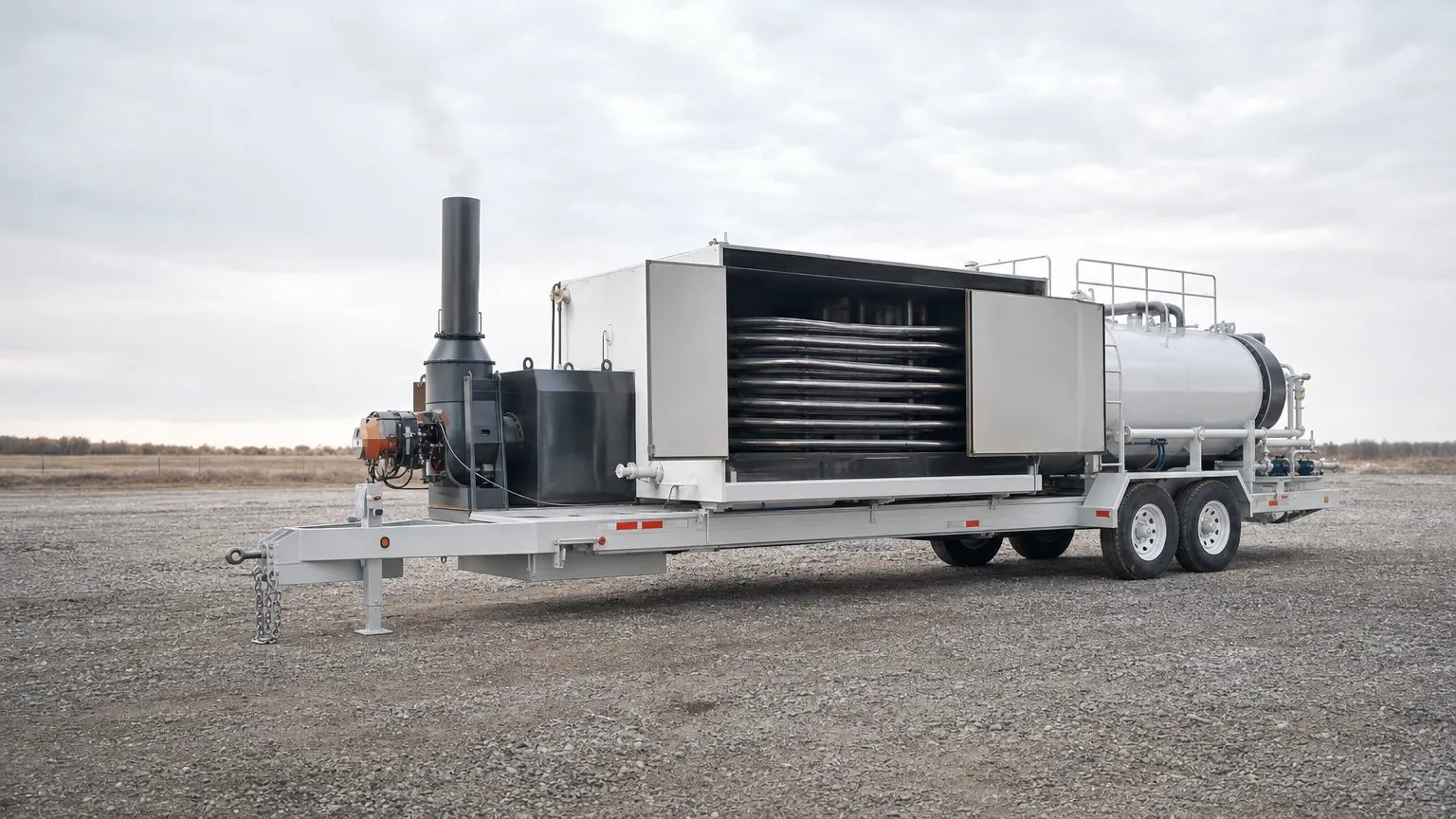
Frac chemistry is designed for water in a temperature window. In a Canadian winter, the water arrives far below it. Friction reducers, gels and crosslinkers are formulated to perform at a working temperature; cold water slows hydration, changes viscosity and puts the job design at risk. It can also freeze in lines, valves and tanks. A frac fluid heater fixes that. Here is how one works and how to size it.
The machine
Most frac water heaters are fired coil heaters. Water is pumped through a long coil of pipe inside a firebox; a burner — diesel, propane or natural gas — fires into the box and the heat passes through the coil wall into the water. Some designs heat indirectly, through a heat-transfer fluid and an exchanger, but the principle is the same: fuel in, heat into the water, warmer water out. Around the coil and burner sit:
- A blower and fuel train — air and fuel in the right ratio for a clean, steady flame.
- Pumps — to move water from the source tanks through the coil and on to the frac tanks or blender.
- Controls — outlet temperature control, flame safeguard, high-temperature and low-flow shutdowns.
- Power and carrier — a generator or engine and the trailer or truck that carries it all.
Two ways to heat
Into storage
The heater circulates water from tanks or a pond through the coil and back, raising the temperature of the whole volume over hours before the job. This is frac tank heating, and it lets a modest heater serve a large job.
On the fly
The heater warms water as it goes to the blender, often heating a stream hot and blending it with cold water to reach the target. This needs a large heater, because the heater has to keep pace with the job.
Sizing the BTU
Water takes about one BTU per pound per degree Fahrenheit, and a barrel of water weighs about 350 pounds. So the heat needed is roughly:
BTU per hour = barrels per hour × 350 × temperature rise (°F)
Heating 1,000 barrels an hour by 60°F needs about 21 million BTU per hour delivered into the water — more at the burner, because no heater is perfectly efficient, and more again in wind and deep cold. Run the same arithmetic the other way and a 40 million BTU heater delivering, say, 32 million BTU into the water raises about 1,500 barrels an hour by 60°F. Treat these as first estimates; the heater maker's ratings and your fluid design govern.
Reading the plate
The fleet of five Vita International diesel heaters we sold reads like most: a BTU rating (16, 18 and 40 million BTU per hour), a working pressure (150 psi on all five), a fuel and a serial number. The BTU rating tells you the duty; the pressure rating tells you what the coil and plumbing were built to hold; the hours tell you how much of the coil's life is left.
Heater, hot oiler or both
A hot oiler is a smaller fired heater on a truck. For tank heating and modest pre-heating it can be enough, as our note on hot oilers for frac heating explains, and our hot oiler BTU guide uses the same arithmetic at a smaller scale. For high-rate programs, a dedicated heater wins.
To spec and inspect a unit, read the frac water heater buyer's guide, then send us your numbers through our frac water heaters page. We source, inspect in Canada and ship worldwide.