
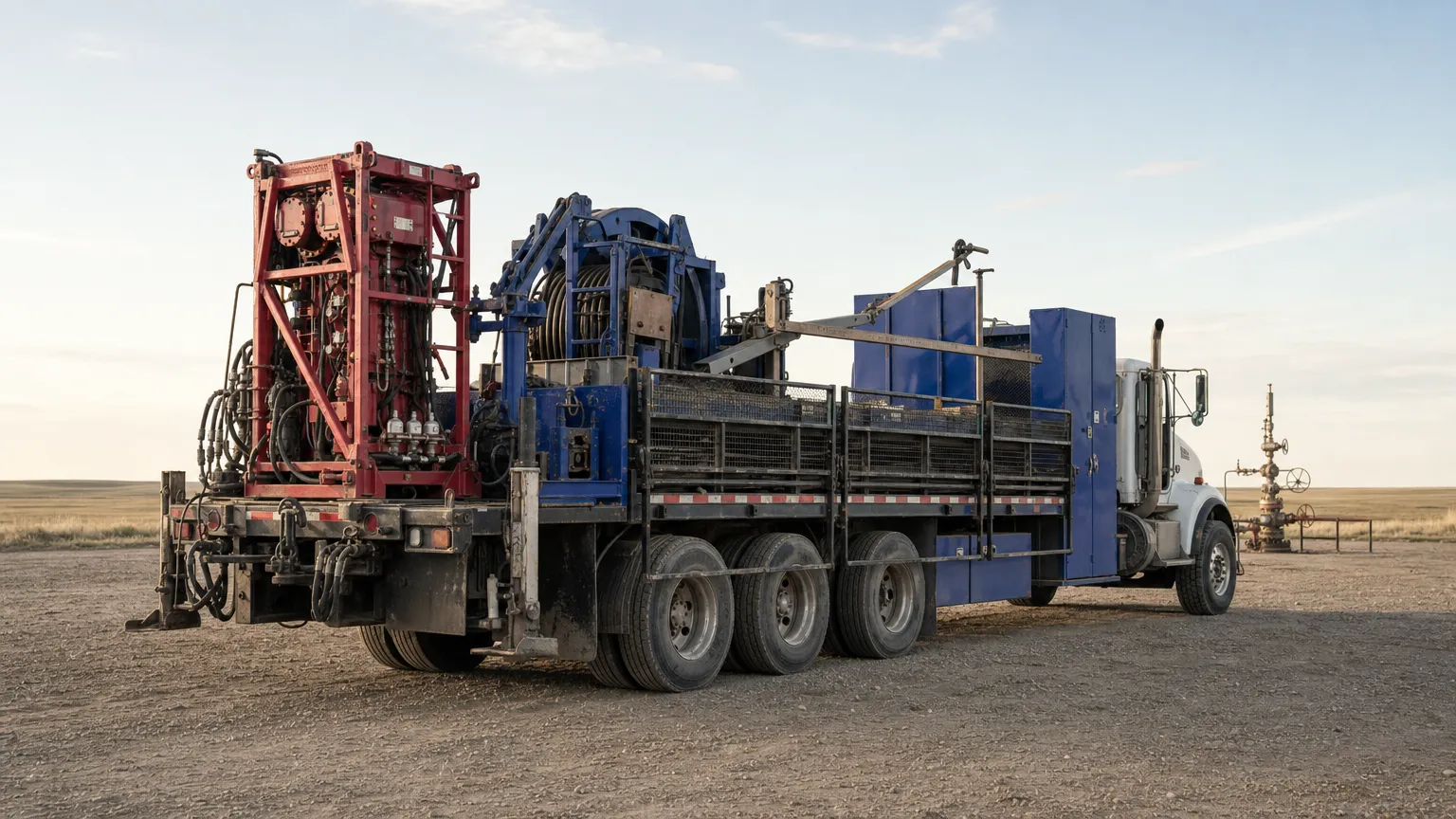
Most well-servicing equipment handles pipe in joints: screw one on, run it, screw on the next. A gripper unit handles a string with no joints at all. It takes a continuous rod or a small tube off a reel and drives it into the well in one piece, gripping it as it goes. Here is how it works, what it runs and where it fits.
The parts
- The gripper — the injector itself. Hydraulically driven gripping elements squeeze the string and push it into the well or pull it out, at a controlled speed. Its rating is its pull capacity: 30,000 lb on the Celtic Pride gripper on our sold Unit 200.
- The guide — a curved arch of guide pieces that carries the string from the reel, over the top and down into the gripper without kinking it. On Unit 200 it was a 51-piece guide.
- The reel — the spool that stores the string, with its own drive and brake to keep tension steady.
- The safety brake — a mechanical brake that holds the string if hydraulic pressure is lost, so it cannot fall into the well.
- Lifting and handling — a picker crane to set the gripper and guide over the wellhead, a deck, catwalks and a gripper stand for transport.
What it runs
Continuous sucker rod
In Western Canada the gripper unit is best known for continuous rod: a sucker rod string with no couplings, spooled on a reel and run by a gripper instead of being made up joint by joint. Without couplings, rod and tubing wear less where they rub, and the string runs and pulls faster. Unit 200 was set up for exactly this, with a reel for continuous rod and the gripper, brake, bag and guides to run it.
Capillary strings
Small stainless tubes run inside production tubing to deliver chemicals to the bottom of a well — scale and corrosion inhibitors, foamers, paraffin treatments. Installing them into a live well is the job our note on capillary string injectors covers.
Small-diameter tubing
Velocity strings and other small tubulars that help gas wells lift their liquids, conveyed through pressure control without killing the well.
Where it fits
A gripper unit sits between three other machines. A flushby unit pulls jointed rods and flushes tubing; a gripper unit does the rod work on continuous rod. A coil tubing unit runs much heavier coil with a large injector head for cleanouts and milling; a gripper unit handles the light end of continuous strings at a fraction of the cost. A service rig pulls tubing and does completions, which neither can. Our comparison of gripper units and coil units draws the line in detail.
Mounting
Most gripper units are truck-mounted — gripper, guide, reel and picker on one chassis, so a single crew can drive to the well and work the same day. Trailer and skid packages exist for sites where a dedicated truck does not pay, as our note on gripper trucks explains.
Buying one
The mobile gripper buyer's guide lists what to inspect. Gripper units sell fast, so we source them to your specification through the mobile gripper units page, inspect them in Calgary and ship them worldwide with export documentation handled.