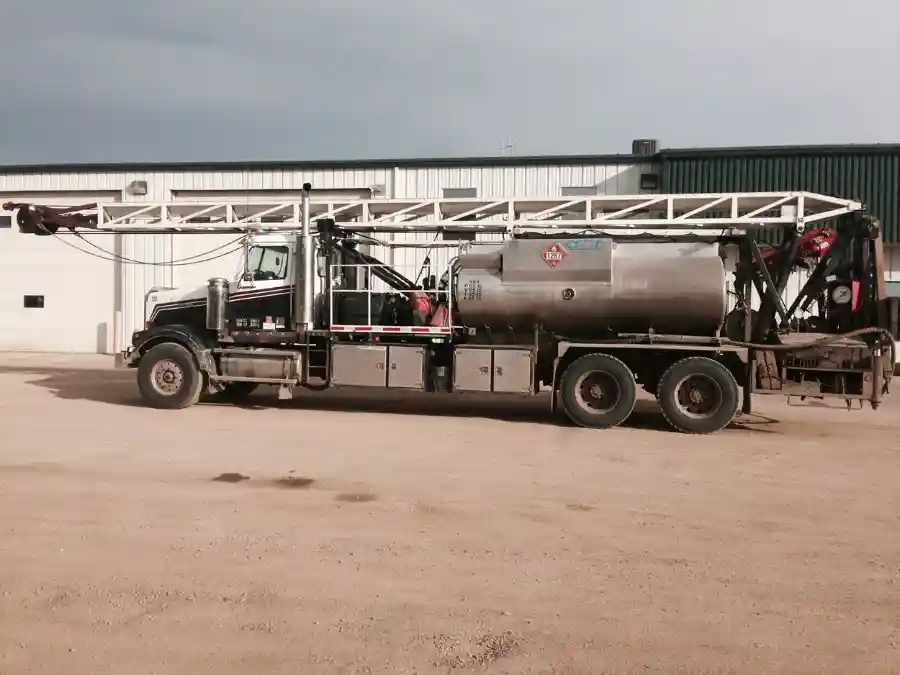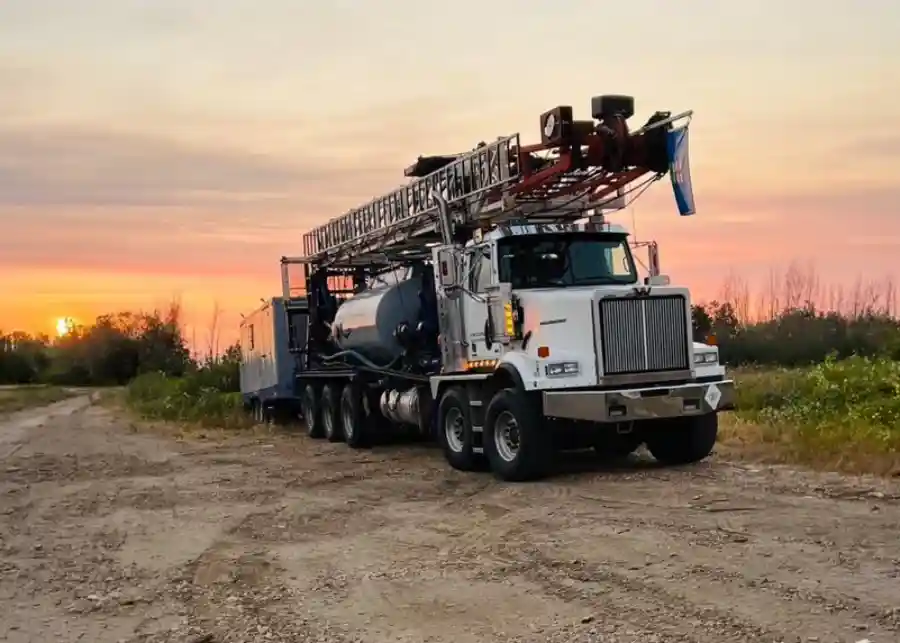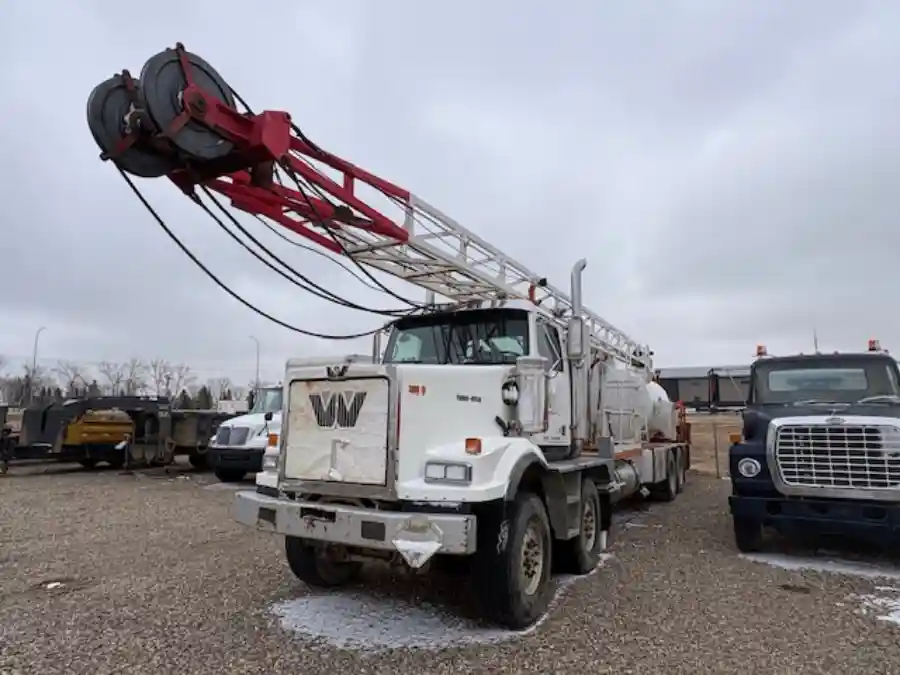
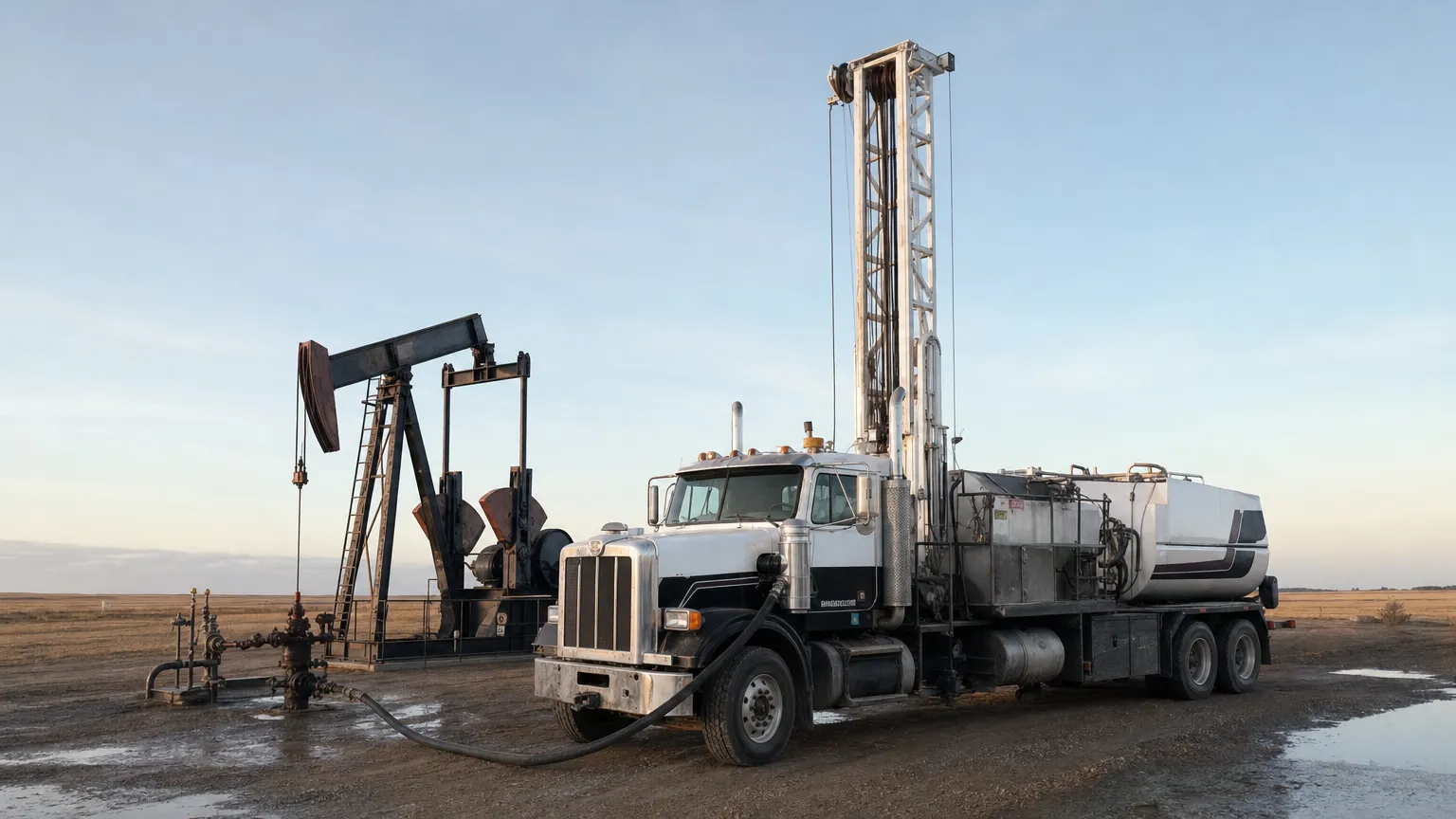
A pumping well fails in small ways, often: a worn pump, a waxed-up tubing string, a sanded-in barrel. The flushby unit exists so that none of those small failures needs a service rig. It pulls rods and flushes tubing from one truck, in one visit, and puts the well back on production the same day. Here is how it works, what it is called and where it stops.
What is on the truck
- A mast — 47 to 72 feet clear under the crown, telescoping on the taller units, rated 50,000 to 70,000 lb and sometimes certified for slant wells.
- A drawworks or winch — the drum, brakes and drill line that lift the rod string, with an auxiliary winch for tools.
- A triplex pump — typically a Gardner Denver 3x5, building 5,000 to 6,000 psi and more, that circulates fluid down the well.
- A tank — a 406 crude tank of 6 to 9 cubic metres, often in compartments, for the flush fluid.
- Hydraulics and controls — mast raising, outriggers, rod handling and the operator station.
The jobs
Pump changes
Rig up over the wellhead, unseat the pump, pull the sucker rods, change the downhole pump, run back in and seat it. The most frequent service job on a pumping well, done without mobilizing a service rig.
Tubing flushes
Circulate fluid — often hot oil or hot water supplied by a hot oiler on the same call — down the tubing to melt paraffin, lift sand and clear scale. The flush pump on board is what gives the unit its name.
Stuck pump recovery
A pump sanded or waxed into its seat is freed by flushing and pulling together — the combination a swab rig cannot do and a service rig is too expensive for.
What it is called
Flushby and flush-by describe the flush pump; rod rig describes what it pulls. In practice they are the same machine, and buyers search for all three. A "single mast rod rig", as our 2015 Western Star unit is described, is a flushby with a single-section mast.
Where it stops
A flushby does not pull the tubing string — hook load and mast height are sized for rods — and it does not run completions or fish. That is service-rig work; our swab rig vs flushby vs service rig comparison draws the line, and the workover rigs category covers the heavier iron. Where the job is fluid removal only, a swab rig is lighter and cheaper.
Buying one
The spec that matters is in our note on mast, hook load, pump and tank; the inspection is in the buyer's checklist. The flushby units in our yard — 130, 133, RR112, RR213 and a 2015 Western Star — come off active Western Canadian well servicing, inspected in Calgary and shipped worldwide.